
Substack can now detect if you're using AI, but that's not the part you should be worried about.

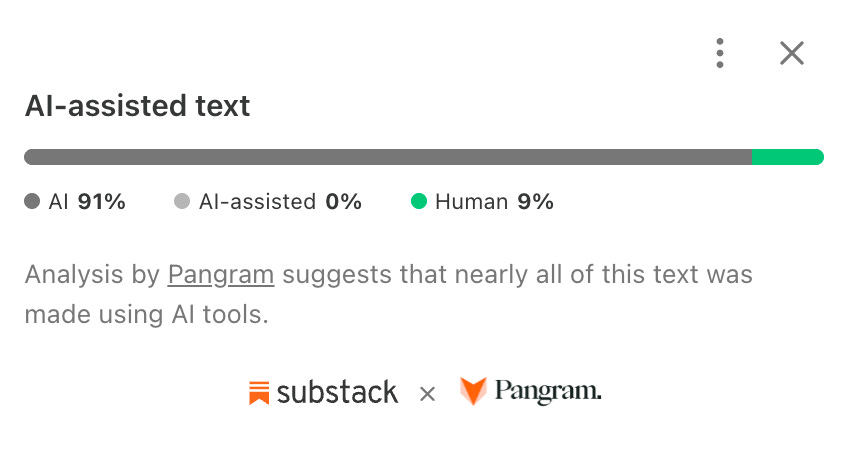
This can be the end of this year’s new Substack writers. The platform just dropped a tool that will let readers scan your or any other Substack writer’s work and get back a number telling them how much you actually wrote, or whether it's AI.
I’ve read a bunch of mixed reviews about this move. I’ve seen all the negativity, as well as people saying that they’re gonna pack up their whole list and go somewhere else. People are arguing and mad about the wrong thing.
But first, let’s break down what happened.
So what did Substack actually do?
Substack partnered with a company called Pangram and rolled out a button that says “Scan for AI texts.”
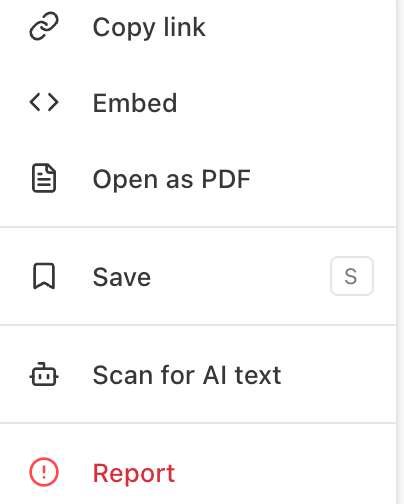
When you tap this feature. You, as the reader, will get an estimate from Substack of how much of what they wrote was written by hand versus AI-assisted or completely AI. It just needs a hundred words to scan, and it will give you a number regardless if it is on a post, notes, comments, etc.
It can’t read or scan any texts that were published before July 21, 2026. So if you were just copying and pasting before, don’t worry, you’re good. Shoot, I even had to check myself.
Now, can I be honest?
There was a season where my whole process was AI. I fully believe if you’re not consistent on social media, it’s because you don’t have a system an AI was giving me that system. I would give Claude a full transcript of my Live or maybe the meetings. It would take my frameworks (aka skills), my brand voice skill, and write everything I needed.
At the time, the reasoning felt correct. I already gave AI my thought process, my frameworks, the transcript. Here’s how I sound. Go ahead. It wasn’t the average. Just create a Substack article or an email with no context.
I looked at it as thinking and delegating the typing.
Now, it wasn’t that that season failed because of me doing that. It just worked so well that I stopped checking it myself. I looked at the drafts and went, “Okay, that’s cool enough.”
Cool enough doesn’t equal standing out.
The content was going out, and it’s not like no one was reporting me or complaining, but they also weren’t commenting and engaging as much. It just didn’t land the way my other stuff landed. I played a very typical role of saying, “The algorithm just isn’t on my side.”
Readers don’t file a complaint. They just continue to scroll. It doesn’t stop them, and it doesn’t make them want to read on. We may think this is super fire and helps with consistency, but the readers don’t care about your consistency. They care about your perspective.
So what made me stop this “system”?
I started reading the drafts out loud, and they were good. I’m not going to sit here and lie and say AI was producing garbage or what everybody wants to continue to say: AI slop, because it wasn’t. The majority of those drafts were better than anything that I would have typed out on a random Tuesday.
But it just wasn’t all the way me. I let a lot of corny lines, if I could be honest, slide through because I thought, “Well, you don’t like to write anyway, so this is better than nothing.” However, the way AI writes is super clean, balanced, perfectly formatted, and I don’t talk perfectly at all.
But lowkey, I was ashamed of my writing. I honestly had gained confidence through AI writing. I should have just learned from it and improved my writing. Allowed AI to assist me only.
I changed up the system a little bit:
I dump all the data first, get everything out of my head, or find a transcript.
The AI takes that and gives me back just an outline.
Instead of asking it to write it, I pull up Wispr Flow and talk everything out while looking at the outline.
I’m reacting to how AI interprets my words with this new workflow instead of a simple copy and paste.
The copy and paste didn’t go away because, for some situations, it doesn’t work. It just went away because I got tired of just publishing “cool enough” content.
This posed a new question with the new Substack tool. Do these platforms even want us using AI or not?
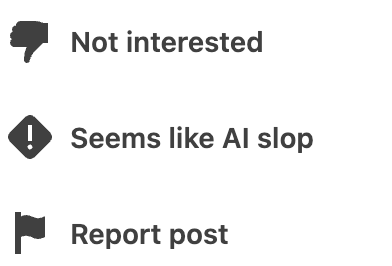
It doesn’t only stop and start with Substack. On July 30, LinkedIn’s Chief Product Officer Hari Srinivasan announced a new report reason called “Seems Like AI Slop.”
YouTube changed its rules May 27:
“If a creator doesn’t specify whether or not they used AI, but our systems detect significant photorealistic AI use, we will now automatically apply a label.”
This is a check they run whether you answer it or not. Pinterest has had a classifier since April 2025. TikTok has been testing invisible watermarks, and Meta has been putting AI info on almost everyone’s posts, regardless of whether it’s AI or not.
Not in anything I said yet has talked about them taking down AI content. They just want to make transparency very clear and start labeling it instead of leaving it up for interpretation, because each week AI is getting better and better.
So does this mean people are done with AI content?
Surprisingly, people are more accepting of AI content than we were a year ago. I see comments on clearly AI content more than I’ve seen on real human content.
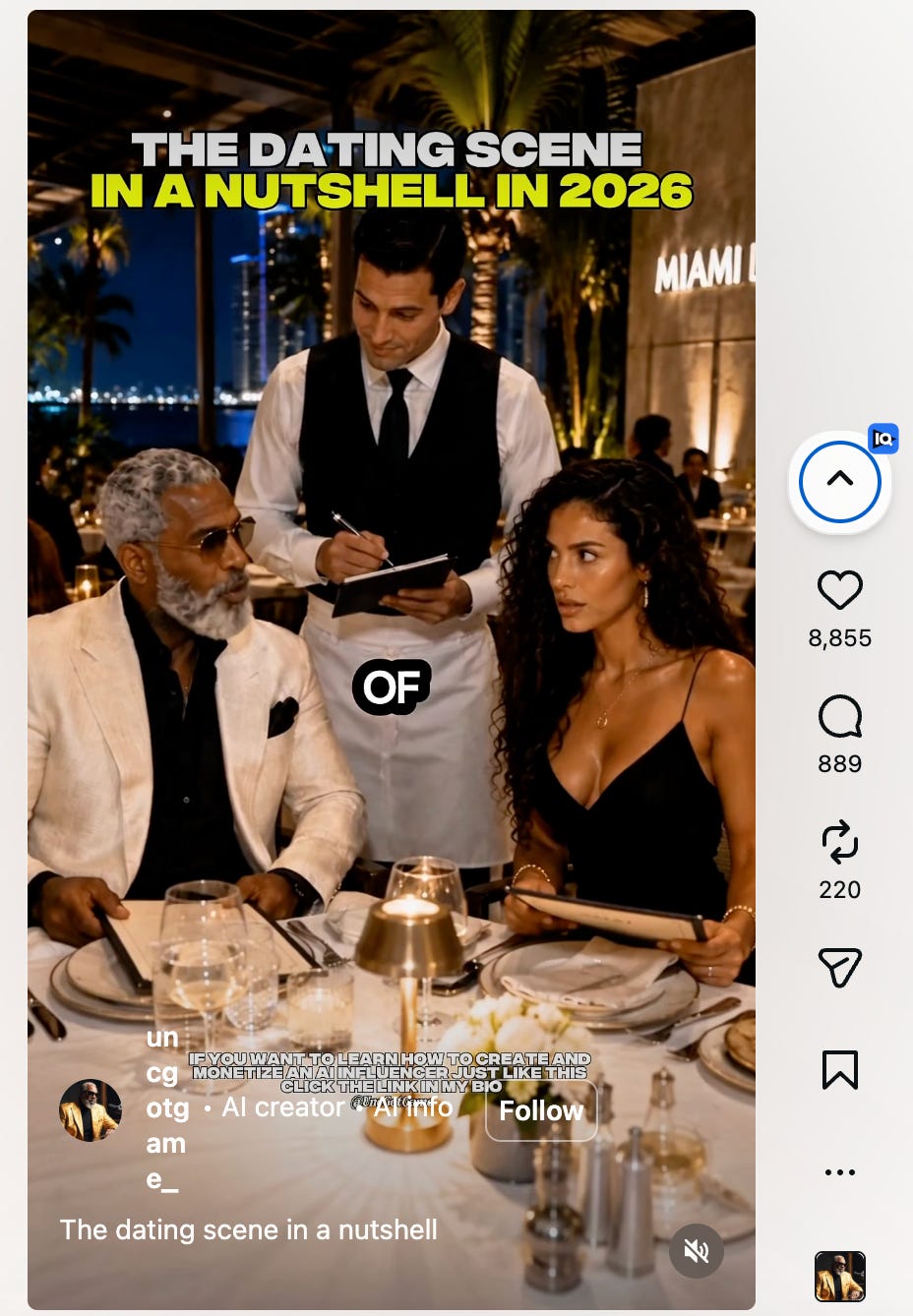
However, there are standards and expectations people place when it comes to this AI content.
For example, I have a member inside of Lions Behavior named Kevin, and all his content on Instagram is his AI avatar. It’s accepted because he started his brand as the AI guy, but also as AI himself. He is proving what’s possible with AI through his own content while building a portfolio for clients.
However, if you started as a human-led brand and you are the face of the brand, you may not have the same types of luxuries (to an extent). Your audience followed you for you, so they’ll probably be okay with a little bit of AI here and there because it’s clearly a topic this year. But at a certain point, they’re going to ask, “Where are you?”
Where’s the energy? Where are your words? We followed you for your perspective.
And if they’re already asking those questions, they’re probably already looking for the next person to follow.
I’m all for integration, having AI as the partner. I’m not for AI being the entire operation if you built the thing as a human first.
We’re currently seeing this in the music industry, where people either don’t care at all for AI music, hate it, or, as long as the song is good, I’ll listen. There’s a clear divide in the audience when it comes to AI music. The art of making music is what’s valued. The process of it is what’s valued, and once that’s automated, to some purists, they can’t follow that artist anymore.
Your audience can feel like that about you. One day, you’re the hero, and they’re listening to you. The next day, you are the villain.
So what's the thing I actually can't let go of?
It’s not the writing. It’s not even the workflow.
It’s just that we’re in a world where media runs everything. We control the narrative. We move how people think, buy, trust, and what they believe is possible, even for themselves.
That’s a huge responsibility, all just because we’re making content. However, consistent content to the right people creates influence. Some people take this responsibility completely seriously, and others are extremely nonchalant about it.
If you automate the perspective side of your brand, you’re going to have to sit with what that actually means. You become the reason a whole bunch of people think a certain kind of way, and sometimes it doesn’t fully come from you.
Let’s be honest: it came from a program. It came from a company with a whole bunch of money behind it, and we cannot confirm or deny whether their agenda is slipped in through some of these chat outputs. And since there’s not a definite no to that question, that’s the scary part about it.
That’s why I always say, “Never just go into AI and say, ‘Give me an idea,’ and just run with it.”
Your voice was made for a reason. You’re here for a reason. You can’t automate that reason.
Here are four things I actually do now that you can steal today
Data Dump Before You Prompt
Talk or type everything you know about the topic you want to talk about. It could be unstructured, not clean, and ugly is fine. Ugly is how it’s supposed to look, and then let AI turn your mess into an outline. That’s the only job that you’re giving it.
Talk the draft. Don’t read it
When reading the outline, you’re not just reading it back. You’re reacting to it. AI just organized your thoughts, and by you speaking it out loud, it takes the data dump that you did into your own version of an organized draft.
Know which side of the line your brand sits on
Ask yourself one question: Did my audience come just for the output, the information, or did they come for me? One of my mentors always told me, “Do you want to be a weather broadcaster or a weather changer?” For me and my brand, I want to be a weather changer. Information you can find anywhere now. ChatGPT, Claude, and Gemini make it very easy for that. But your perspective can’t be found everywhere.
Automate the production, never the perspective
Automate things like research, formatting, repurposing, transcripts, insight reports, etc.
Detection is only going to get better. I am not saying do not use AI because I am a huge AI advocate in helping get some of your time back. What I’m saying is these AI detection tools are really good. Reality check: see if you’re allowing these AI companies to shape their perspectives through your voice and your platforms, or if you still have control of that.
I write my articles using ChatGPT to take my thoughts, experiences, and ideas to create full length articles. All ideas are authentic, AI is my ghost writer.
Been watching, and adjusting accordingly. I don't shy away from the fact that I use AI as a creative, but I've always been a writer, and you can't take that from me. There's a huge difference between directing AI, and copy n pasting whatever, we don't do that round here...✍️🏾🦁